I was thrilled to learn that Starbucks CEO Howard Schultz used Starbucks as a communal vehicle to catalyze a civic reaction to our government’s inaction. Ultimately, the online petition launched on October 10 gathered 1.5 million signatures over 3 days. Bravo to Mr. Schultz for leveraging Starbucks’ social capital for civic engagement.
The petition is as straightforward as a black cup of coffee (not easy to find on the Starbucks menu)
• Reopen the government;
• Pay our national debts on time; and
• Pass a long-term budget deal by the end of 2013.
Most Americans embrace these principles and agree that our representatives should be serving our best interests. Avoiding default and its disastrous results was undoubtedly a desirable choice. Yet our leaders consistently choose not to compromise or engage in civilized or constructive political discourse. Time and time again, they have chosen to take us to the brink of disaster and then adopt a last minute plan to kick the can down the road. Where else do employees get rewarded for making such bad choices?
What is more troubling is that we the people are allowing it. I hold myself accountable first. My life, like most citizens, is a whirlwind of obligation and activity. I am a single woman who’s buying and selling a home, working on a start-up business, managing a nonprofit civics project, being a mother and grandmother, and staying involved in my community, while recovering from a knee surgery that didn’t go well over a year ago. It’s so much that I excuse myself from one of the most important activities of all—being a good citizen.
Like so many, I’ve been outraged by our politicians’ behavior. In our daily lives, we negotiate and make compromises all the time. We learned that lesson early on in the sandbox, in the school cafeteria and at recess (before it got cut from school budgets). The rigid get left behind, the flexible adapt. Ideologues may be interesting to listen to, but we don’t want to live with or work for them, and we certainly don’t want them working for us. However, I’ve been too busy with my life to do much other than vent with friends and family about the horrifying beltway paralysis. Instead, I hoped that someone else would do my job because I was too busy living my life. I hoped that business and civic leaders’ influence and negative media polling would be sufficient in appealing to the minds and hearts of our representatives. Shame on me, shame on so many of us!
While we narrowly averted disaster, that doesn’t let our elected officials off the hook—or us. Especially us. They work for us, not the other way around. Now is the time to let the White House know and Congress know that we expect them to work things out. We have been working it out for nearly 225 years. The process is never perfect and no one gets it all their way. Thomas Jefferson did not like the fact that we invoke religion at all. Ben Franklin endorsed the Constitution saying, “I consent, Sir, to this Constitution because I expect nothing better, and because I am not sure that it is not the best.” Some historians call the Constitution itself “A bundle of compromises” because of the concessions that our Founders knowingly made to create it.
It’s time for our elected leaders to get into the sandbox together. Forget running all the games your way on the playground. Stop trying to score political points, as the American people have to be the ultimate winners. Complete your homework on time and do your job, like most Americans do every single day. Don’t award yourselves special privileges for doing so. You’re not entitled.
And fellow citizens, let’s make sure they hear us loud and clear. Talk with your loved ones, communities, and colleagues. Write, call, petition, demonstrate and vote. Nothing is more important in our busier lives than this. We cannot create a More Perfect Union if we continue to sit by as spectators in our democracy. Let’s be the people of our Constitution. Our future depends on it.

Friday, October 18, 2013


Wednesday, August 7, 2013
Celebrating the Us We All Will Become
As my 3 year old grandson likes to say, we have “a big problem” in America. We are living longer but we’re uncomfortable with old age. When given the option, we often put our aging elderly in facilities and special programs where our old people essentially become someone else’s problem. We know that it is better for everyone when our older citizens stay in their homes and communities and live independently—“ aging in place” –for as long as they can. They stay healthier and happier longer. And we have the benefit of their wisdom to enrich our communities and our lives. We used to have extended family networks, small towns and tight knit neighborhoods to support this possibility but now we must create new social infrastructure to help our seniors stay put for as long as they can in safety and with dignity.
Organizations are sprouting up around the country to do this. Northwest Neighbors Connecting founded in Baltimore in 2012 works on the Village Model (89 exist in this country and 123 are under development). It focuses on the needs and strengths of its members so that all members are connected through relationships in community. Members across generations drive, mentor, do errands, coach, tell stories and engage in essential activities with one another. Risyl Edelman, their new director wrote this beautiful reflection to share with the NNC community after the death of her husband’s grandmother last week. Her grandmother had the great fortune to have a remarkable family support system. Most of us can’t rely on that as we age, but I imagine that most of us would like to experience a version of what Risyl describes as our end of life experience.
“My husband’s grandmother – Ruth Edelman – died in her own home at the age of 98. In the last five years, beginning with the frequent falls of her husband of 76 years, and slow rise of dementia, her husband – Marvin Edelman was cared for daily by Rhoda Blackwood and her care-giving service. When Grandpa Marvin passed two and a half years ago, Rhoda remained in place to care for Grandma Ruth, who missed her husband’s funeral due to a fall of her own – and was recovering in Levindale with a fractured hip.
Rhoda and her family and occasional staff never missed a day of care in the last five years. I know my in-laws are BEYOND grateful to them and will sing Rhoda’s praises to anyone who will listen. They encouraged me to invite Rhoda to join NNC’s board, insisting that she is on the front lines of the aging in place challenge.
It has been inspirational to say the least for me to watch my in-laws care for Grandma Ruth. Senior citizens themselves – (they should be well) – they have been there consistently to love, support and provide care in ways that I can only HOPE I will one day be able to aspire to. The fact that my father in law is a physician was very handy as the physical needs of his parents became more and more demanding…
Grandma Ruth’s soul was escorted out of her home last night in the presence of her son and daughter in law, two grandsons and their wives, 9 great grandchildren – plus 3 of THEIR spouses, a close family friend, along with Rhoda and her cousin Paulette. It is a source of great comfort to know the love and closeness of the family – and I feel good that I brought three of her great, great grandchildren to visit her on Sunday.
May we all find comfort in our relationships and continue to value our connections.”
May all of us know the blessing of long life and the privilege of sharing it with people we love to the very end. May we also learn truly to celebrate the us we all will become.

Northwest Neighbors Connecting
Organizations are sprouting up around the country to do this. Northwest Neighbors Connecting founded in Baltimore in 2012 works on the Village Model (89 exist in this country and 123 are under development). It focuses on the needs and strengths of its members so that all members are connected through relationships in community. Members across generations drive, mentor, do errands, coach, tell stories and engage in essential activities with one another. Risyl Edelman, their new director wrote this beautiful reflection to share with the NNC community after the death of her husband’s grandmother last week. Her grandmother had the great fortune to have a remarkable family support system. Most of us can’t rely on that as we age, but I imagine that most of us would like to experience a version of what Risyl describes as our end of life experience.
“My husband’s grandmother – Ruth Edelman – died in her own home at the age of 98. In the last five years, beginning with the frequent falls of her husband of 76 years, and slow rise of dementia, her husband – Marvin Edelman was cared for daily by Rhoda Blackwood and her care-giving service. When Grandpa Marvin passed two and a half years ago, Rhoda remained in place to care for Grandma Ruth, who missed her husband’s funeral due to a fall of her own – and was recovering in Levindale with a fractured hip.
Rhoda and her family and occasional staff never missed a day of care in the last five years. I know my in-laws are BEYOND grateful to them and will sing Rhoda’s praises to anyone who will listen. They encouraged me to invite Rhoda to join NNC’s board, insisting that she is on the front lines of the aging in place challenge.
It has been inspirational to say the least for me to watch my in-laws care for Grandma Ruth. Senior citizens themselves – (they should be well) – they have been there consistently to love, support and provide care in ways that I can only HOPE I will one day be able to aspire to. The fact that my father in law is a physician was very handy as the physical needs of his parents became more and more demanding…
Grandma Ruth’s soul was escorted out of her home last night in the presence of her son and daughter in law, two grandsons and their wives, 9 great grandchildren – plus 3 of THEIR spouses, a close family friend, along with Rhoda and her cousin Paulette. It is a source of great comfort to know the love and closeness of the family – and I feel good that I brought three of her great, great grandchildren to visit her on Sunday.
May we all find comfort in our relationships and continue to value our connections.”
May all of us know the blessing of long life and the privilege of sharing it with people we love to the very end. May we also learn truly to celebrate the us we all will become.
Northwest Neighbors Connecting
Thursday, July 4, 2013
Carrying the Flag
This morning, a friend of mine sent me this you tube video which features three women, Carmen, Elaine and Joanne in Freeport, Maine who started something in response to 9/11 and haven’t stopped since. http://www.youtube.com/watch?v=jV4CF2kuDCo
Freedom’s Feast started too in the immediate aftermath of 9/11. Just like these women, I felt the need to do something to help rebuild the spirit of our country, to reaffirm our essential purpose and values and pass on vital lessons to our next generation of citizens. With the help of many wonderful advisors and institutional partners, we haven’t stopped since.
When these wonderful Freeport citizens took the flag in person to the street of their community, they made a powerful statement. “We stand with you and this symbol of what our country represents.” When the "Freeport Flag Ladies" decided to come back the next week and the week after that and the months and years after that, they said something even more profound: “Our commitment as citizens is unassailable. It endures regardless of weather, illness, inconvenience.” They’ve carried that message to schools, churches,community centers, airports—wherever Americans gathered and needed that inspiration.
I don’t know what their personal politics are and don’t want to know. These women come from Maine and are likely fiercely independent. What I admire is their commitment, determination and decision to do something that they thought would make a difference at a time when they believed something needed to be done.
On this Independence Day 2013, I'd like to celebrate that about us. We follow a long and honorable tradition of ordinary citizens seeing what needs to be done and doing it. We pick up the flag and we carry it.
Carrying the Flag
This morning, a friend of mine sent me this you tube video which features three women, Carmen, Joanne and Elaine from Freeport, Maine who started something in response to 9/11 and haven’t stopped since.
Freedom’s Feast started too in the immediate aftermath of 9/11. Just like these women, I felt the need to do something to help rebuild the spirit of our country, to reaffirm our essential purpose and values and pass on vital lessons to our next generation of citizens. With the help of many wonderful advisors and institutional partners, we haven’t stopped since.
When these wonderful Freeport citizens took the flag in person to the street of their community, they made a powerful statement. “We stand with you and this symbol of what our country represents.” When they decided to come back the next week and the week after that and the months and years after that, they said something even more profound: “Our commitment as citizens is unassailable. It endures regardless of weather, illness, inconvenience.” They’ve carried that message to schools, churches, community groups, airports—wherever Americans gathered and needed that inspiration.
I don’t know what their personal politics are and don’t want to know. These women come from Maine and are likely fiercely independent. What I admire about "the Flag Ladies of Freeport" is their commitment, determination and decision to do something that they thought would make a difference at a time when they believed something needed to be done.
On this Independence Day 2013, I'd like to celebrate that about us. We follow a long and honorable tradition of seeing what needs to be done and doing it. From our founding to now, ordinary citizens pick up the flag and we carry it.
Monday, February 18, 2013
The Buck Stops Here
I just deleted the latest of maybe 30 promotional emails from the past three days urging me to take advantage of Presidents’ Day sales events. That doesn’t count the 30 to 40 that came in during the past week and the bunches of fliers that arrived in the mail. (I keep cancelling—they keep sending.) We all love a good bargain and it got me thinking. How much money will Americans actually spend over the Presidents’ Day holiday? I can’t find a good estimate but every retailer seems really interested in getting us to come through their real and virtual doors.
Most of us won’t even use cash but if we do, it’s a great opportunity to remember the reason why we’re out there spending money in the first place. It’s Presidents’ Day! When congress chose to set aside the third Monday in each February for this holiday, they reaffirmed the holiday for Washington but unofficially split the difference and marked the birthdays of two of our greatest presidents—Washington and Lincoln.
George Washington, our first president, born on February 22, is featured on quarters, every $1 dollar bill and on the new Presidential gold dollar series. Lincoln, born on February 12, is featured on pennies, the $5 dollar bill and also on the new Presidential gold dollar series. By 2010, 23 presidents were featured on our currency. In each year since, another four are added through the Presidential Gold dollar series which adds four more deceased presidents to the series in each year through 2015. Mint policy requires that currency features only deceased individuals although we have honored historical figures other than presidents.
Still it seems fitting while we’re out snagging bargains to consider the day and its purpose. Who were these men? What did they mean to us and our country? I have my own answers which change a little every year as I change and my perspective on our country changes. Washington was our wealthiest president by all measures but he swore off the trappings of privilege in office and rode a simple coach all the way to his inaugural celebration. At a time when leaders of nations were still anointed royalty, he set the tone for presidential conduct modeling humility, dignity, transparency and intelligence. I love that his visage graces our $1 bill, the anchor of our enterprise system.
Lincoln was the consummate politician tempered by compassion, tested by his own personal tragedies, witty and wise. Determined and wily, he used all of his political and social capital to pass the 13th amendment to abolish slavery because he did not think a better time would come again even though it might cost him his life. How fitting that this self-taught lawyer from the back-woods of Illinois adorns our simple penny.
What other presidents deserve our attention and praise on this day? What do they teach us that we want to teach our children to celebrate? Lay out some bills and coins on the dining room table and say,” Look who’s come to dinner!” or start with the sign that sat on Harry Truman’s desk: “The buck stops here.” That will definitely get their attention. Happy Presidents’ Day!
Thursday, January 17, 2013
Babies and Big Brothers: two year old greetings for a new sister
“I just want to see my sister!” proclaimed Roy, my two year old grandson, when he learned yesterday morning that his mom,Natalie, had gone to the hospital to give birth to his baby sister. I explained that he would see her later that day. I had his backpack, snack, and instructions for delivering him to his pre-school program, but some other instinct made me dawdle as we fixed his breakfast and my morning tea. By the time we’d completed 3rd breakfast (he’s tiny as a Hobbit but has not yet read either Tolkien or Mann’s "Magic Mountain") school opening was past and his dad called to share the news that his sister had arrived. Arrived is a genteel word for it. They pulled into the hospital parking lot at 8:08 am and she was born at 8:29 am. This baby wanted to be born. And her older brother, insistent once more, declared, “I want to see her! I need to see her.” How many times does a brother get to see her sister on her first day of life? Pre-school could definitely wait.
Once we arrived at the hospital, Roy kept up a steady stream of chatter. “Is that big red building the hospital? Is that where my mommy and baby sister are? Can we take an escalator to go see them?” Yes, yes and no. He was elated to see his mommy whom he’d last seen 7 hours before but instantly dismayed to learn that his sister was still in the nursery. The nurse was bringing her to us shortly. “But this is not the right room! This is wrong. I have to find my sister!” and burst into tears. “I want to see her."
I reached for his hand. “Let’s go find your sister, Roy. We need to go look for the nursery. OK, daddy?” We quickly became an entourage—Roy, daddy and four grandparents in tow. The two sets of grandparents immediately hugged and kissed each other and exchanged a “Mazel tov” upon arrival at the hospital . There is no greater blessing, few things better to celebrate than a new grandchild in the world. We were able to divert Roy’s escalator disappointment with a brief tour of the build a bear shop while waiting for our visitor’s badges a second time (at this hospital you don’t get on the labor or maternity ward without surrendering an identity card in exchange for a temporary badge). And after two more turns, we were suddenly staring through the gridded glass trying to locate our baby who was RIGHT there parked in front of our faces. As we pointed to this delicate creature with rosy pink coloring and pursed lips just like her brother’s, Roy squealed, “There she is, there’s my sister! Why, she’s a little baby.“ And then without a beat, making his first naked calculation as a sibling from the midst of toddler-hood, he proclaimed,“I want to be a baby.”
Alex patiently responded, “You once were a baby, just like Alana. In this same hospital. But now you’re bigger. Big enough to be a big brother.”
“She’s such a little baby.” (Maybe I’ll have to cede some ground here). “I want to be the big brother. Why is she wearing that little pink hat?” And off we went on a discussion of babies, thermal heat loss and how tiny they are.
He returned to give his mommy a good bye kiss before leaving and as I buckled him into his car-seat for the ride back home he said, “I saw my baby sister at the hospital. I'm so happy.That was a good adventure.” (We refer to all of our outings as adventures) “Right, Gromzy?” Oh, baby, you have no idea. The adventure has just begun. But if this first day is any indication, Alana Lenore is very lucky to have Roy as her big brother. He taught a group of adults to stop waiting for the most important blessing in our lives and to go see it for ourselves rather than settle for digital substitutes and wait. Some things in life are just too special to wait for.
I wonder how many of us have stories that celebrate us and the way our siblings greeted our arrival into the world? And if we don’t, shouldn't we try to get them?
Once we arrived at the hospital, Roy kept up a steady stream of chatter. “Is that big red building the hospital? Is that where my mommy and baby sister are? Can we take an escalator to go see them?” Yes, yes and no. He was elated to see his mommy whom he’d last seen 7 hours before but instantly dismayed to learn that his sister was still in the nursery. The nurse was bringing her to us shortly. “But this is not the right room! This is wrong. I have to find my sister!” and burst into tears. “I want to see her."

I reached for his hand. “Let’s go find your sister, Roy. We need to go look for the nursery. OK, daddy?” We quickly became an entourage—Roy, daddy and four grandparents in tow. The two sets of grandparents immediately hugged and kissed each other and exchanged a “Mazel tov” upon arrival at the hospital . There is no greater blessing, few things better to celebrate than a new grandchild in the world. We were able to divert Roy’s escalator disappointment with a brief tour of the build a bear shop while waiting for our visitor’s badges a second time (at this hospital you don’t get on the labor or maternity ward without surrendering an identity card in exchange for a temporary badge). And after two more turns, we were suddenly staring through the gridded glass trying to locate our baby who was RIGHT there parked in front of our faces. As we pointed to this delicate creature with rosy pink coloring and pursed lips just like her brother’s, Roy squealed, “There she is, there’s my sister! Why, she’s a little baby.“ And then without a beat, making his first naked calculation as a sibling from the midst of toddler-hood, he proclaimed,“I want to be a baby.”
Alex patiently responded, “You once were a baby, just like Alana. In this same hospital. But now you’re bigger. Big enough to be a big brother.”
“She’s such a little baby.” (Maybe I’ll have to cede some ground here). “I want to be the big brother. Why is she wearing that little pink hat?” And off we went on a discussion of babies, thermal heat loss and how tiny they are.
He returned to give his mommy a good bye kiss before leaving and as I buckled him into his car-seat for the ride back home he said, “I saw my baby sister at the hospital. I'm so happy.That was a good adventure.” (We refer to all of our outings as adventures) “Right, Gromzy?” Oh, baby, you have no idea. The adventure has just begun. But if this first day is any indication, Alana Lenore is very lucky to have Roy as her big brother. He taught a group of adults to stop waiting for the most important blessing in our lives and to go see it for ourselves rather than settle for digital substitutes and wait. Some things in life are just too special to wait for.
I wonder how many of us have stories that celebrate us and the way our siblings greeted our arrival into the world? And if we don’t, shouldn't we try to get them?
Saturday, November 24, 2012
A Refrigerator Full of Memories
We are halfway through the Thanksgiving weekend and I am grateful for a refrigerator full of leftovers. Even after sending my daughter, Lindsay, back to New York with food for her annual Sunday “Friendsgiving” gathering, my partner, Rich, and I can still do replays over the next few days. Sure, it may get a little boring but it’s not the food that matters; it’s the memories attached to making and sharing the Thanksgiving meal together with family and new friends.
Shut my eyes, and there’s my grand-nephew, Zach, nearly wriggling out of his skin with excitement because I asked him to introduce our meal with his 1st grade class story of Squanto. He taught us how Squanto learned the English he needed to teach the pilgrims their life saving skills in the new world. Kind monks saved Squanto from Spaniards who had sold him into slavery in the old world and he subsequently ended up in England before returning to his Native American homeland. While we caught up with each other over appetizers before our feast, those who wanted to made gratitude plates.
It was easy to set up a crafts table with heavy duty paper plates, magazines, permanent markers, glue guns, scissors and a box full of embellishments. I didn’t how people would choose to express their gratitude, but I was delighted to see how readily they dove into the project. One guest came near the table and said, “I can’t do this. I’m not an artist!” A few plate-makers immediately responded, “Neither are we, but this is fun. You should try it!” And she did. A few chose to share what they’d made when I asked for volunteers. Four year old Millie explained that her plate featured the Lorax “because this is my favorite book,” and dogs, “because I love all my doggies.” My niece, Lyn, created a plate that spoke to her gratitude for living in a country that protects women’s rights and has given her so many powerful women role models to emulate. Our guest, Tyler, featured Woody Allen at the center of his plate because he is grateful for the brilliance of Woody Allen. The range of expressions varied as widely as the people in the room which is so American.
Others had written six word memoirs inspired by Larry Smith’s brilliant six word memoirs site.Tyler understood right away that Hemingway, the writer known for his terse prose, must have inspired Smith when he wrote his shortest novel ever: “Baby shoes for sale. Never used.” Lindsay and I had gone online earlier that morning and cherry picked eight of our favorite Thanksgiving memoirs to give our guests samples for inspiration. My dad, at 85, left everyone laughing with his: “I’m with it. I get it.” And he does. Sometimes his penetrating questions and detailed recollections leave some of us wishing we were as sharp at half his age.
We laughed, created,reflected and then once again feasted on Rich’s amazing fried turkey now augmented by a smoked alternative, the new favorite, and the array of dishes contributed by each family. So even though this has been a tough year of a hard surgery gone bad for me, when I open the fridge I smile. I survey the shelves, celebrate us again and pray that all over the country—no matter what our circumstances—all of my fellow Americans found something to be grateful for on this Thanksgiving.
Shut my eyes, and there’s my grand-nephew, Zach, nearly wriggling out of his skin with excitement because I asked him to introduce our meal with his 1st grade class story of Squanto. He taught us how Squanto learned the English he needed to teach the pilgrims their life saving skills in the new world. Kind monks saved Squanto from Spaniards who had sold him into slavery in the old world and he subsequently ended up in England before returning to his Native American homeland. While we caught up with each other over appetizers before our feast, those who wanted to made gratitude plates.
It was easy to set up a crafts table with heavy duty paper plates, magazines, permanent markers, glue guns, scissors and a box full of embellishments. I didn’t how people would choose to express their gratitude, but I was delighted to see how readily they dove into the project. One guest came near the table and said, “I can’t do this. I’m not an artist!” A few plate-makers immediately responded, “Neither are we, but this is fun. You should try it!” And she did. A few chose to share what they’d made when I asked for volunteers. Four year old Millie explained that her plate featured the Lorax “because this is my favorite book,” and dogs, “because I love all my doggies.” My niece, Lyn, created a plate that spoke to her gratitude for living in a country that protects women’s rights and has given her so many powerful women role models to emulate. Our guest, Tyler, featured Woody Allen at the center of his plate because he is grateful for the brilliance of Woody Allen. The range of expressions varied as widely as the people in the room which is so American.

Others had written six word memoirs inspired by Larry Smith’s brilliant six word memoirs site.Tyler understood right away that Hemingway, the writer known for his terse prose, must have inspired Smith when he wrote his shortest novel ever: “Baby shoes for sale. Never used.” Lindsay and I had gone online earlier that morning and cherry picked eight of our favorite Thanksgiving memoirs to give our guests samples for inspiration. My dad, at 85, left everyone laughing with his: “I’m with it. I get it.” And he does. Sometimes his penetrating questions and detailed recollections leave some of us wishing we were as sharp at half his age.
We laughed, created,reflected and then once again feasted on Rich’s amazing fried turkey now augmented by a smoked alternative, the new favorite, and the array of dishes contributed by each family. So even though this has been a tough year of a hard surgery gone bad for me, when I open the fridge I smile. I survey the shelves, celebrate us again and pray that all over the country—no matter what our circumstances—all of my fellow Americans found something to be grateful for on this Thanksgiving.
Tuesday, November 6, 2012
Voting Lessons
A few weeks ago, an educator friend wrote to me in desperation. “I can’t find any good resources for teaching young kids about the voting process.” She didn’t want a text book. She wanted great exercises that she could adapt to her kindergarten classroom and share with other teachers in her primary school program. I didn’t believe that, especially in an election year, there was nothing out there. But I soon had to agree with her. It was really hard to find “good resources.”
After some digging around I sent her to The Center for Civics Education which has been creating substantive civics materials for promoting healthy democracy since 1964. I also suggested The Constitution Center in Philadelphia which brings the meaning of our foundational documents to life although their lessons were targeted to an older audience. Family activities that appeared to be quite engaging weren’t loaded onto the site each time we tried to access them. And finally, I suggested that she take a look at this lesson plan posted on the Scholastic site. I thought a talented educator could adapt it for bright, younger students.
Most of the other material I found came packaged with political agendas that tainted what was often a decent intention: democracies must engage their youngest members early in order to create good citizens. But the key idea is engagement, not brainwashing.
My plea today is please vote if you have not already done so. Share that fact with your children if you have children of voting age and urge them to vote too. If your children are young, take them with you to the polls. Let them see how important this privilege and responsibility is. Share stories about voting with them. I remember going with my Mom to vote when I was a kid. I never forgot the moment of solemnity when I stepped into the voting booth with her and she pulled the lever closing the curtains behind us to protect the privacy and importance of her choices. The long line of voters told me that every adult there valued the same thing. Tell your children what is happening all around the world as people fight and die for the right to vote and remind them that a long time ago, we too fought for the right to be independent and free so that each of one of us could have a voice in our own government.
Citizenship should be taught in our schools, but it must be taught in our homes. We the people are responsible for our country—no one else.
Tuesday, September 11, 2012
Remembering 9/11
September 11 is here again.On the east coast it seems to arrive most often with the crystal clear skies and crisp air of the original 9/11. Stepping outside on the anniversary to weather like this transports anyone who was there instantly back to where they were that morning. Somehow the beauty of the day added to the horror. How could something so terrible happen in the midst of such magnificence?
Perhaps that is part of the lesson we have all taken away. Life sometimes works that way. One moment we are celebrating, the next instant we are mourning and then somehow we are rebuilding our lives again.We can't live poised on the precipice, always wary and waiting for tragedy but when it happens, we must not allow it to destroy our lives. It becomes part of who we are. We are changed in our capacity to celebrate as the remarkable families and individuals who lost loved ones demonstrate year after year in their 9/11 memorial tributes. Our nation has watched toddlers turn into teens and children transform into young adults who speak movingly of the impact of this event on their lives. We all have a stake in who these children become. It's America. We're still a community of communities. The circles of influence and impact ripple out and many of us in the years since have discovered a personal connection with at least one family or individual personally affected by a 9/11 loss.
Yes we are moving on, but this will always be a part of who we are. It is one of the threshold events in American history that changed all of us forever. We cannot move forward without understanding what this moment means to us. The poem below expresses how I felt on the evening of 9/11. What's interesting to me is that 11 years later with Osama Bin Laden dead, the war in Afghanistan still on, and polarized political discourse paralyzing Washington, I remain fundamentally committed to these ideas. What I wish for now more than ever is that we pursue these qualities for ourselves- as individuals and as a nation.
September 11, 2001
This is one of those moments.
The kind that instantly sears the collective memory of a people.
This morning our country was raped
by a gang of terrorists.
A penetration so deep, a taking so violent
that we are all still shaking from the violation.
Everyone knows where they were when it happened--
a moment captured in the amber of the psyche,
preserved in a single shared image.
The trade center vanishing into the earth
in a mushroom cloud of debris and dreams,
as final as the Challenger exploding in the sky,
as dramatic as Jackie-in-pink cradling Jack.
With the trade center went the last vestige
of our innocence down down down.
That is the point of course--
to take us down.
To take lives and then our life.
And of course it will not work.
We will stagger and reel as we calculate our losses,
mourn our dead, scrape up the bits and pieces of
shattered lives in our skies and fields and streets and hearts.
And then because we know that evil exists, but we prefer goodness,
because when-given-the-choice we choose life, not death,
we choose blessing not curse,
we will prevail.
The cynics will be out in force flanked by pundits and second-guessers
right and left,
offering their glib assessments, their trenchant prophecies,
as if this was a game and Monday morning matters.
Words will fly as if utterances could heal the wounds
or raise the dead
or rain retribution upon the terrifier.
And we will discover the Truth.
Actions speak louder than words.
All that really matters is the blessing we choose to make of our lives.
Lee M. Hendler
9/11/2001
Tuesday, September 4, 2012
Something to Celebrate on Labor Day
Labor Day just ended and I’m especially wistful because I couldn't host our annual Labor Day event. It’s a traditional picnic with games and a cookout. We always add a few special activities that connect to the purpose of the holiday. Last year, every guest brought a prop that represented the best job they’d ever had. The rest of us had to guess what it was. I worried the adults might think this was dorky and the kids would be self conscious but everyone jumped right in and our riotous Labor Day charades provided wondrous insights into past and current selves. Unfortunately this year I didn’t have the energy for it. I’ve been recuperating since June from a knee replacement surgery with complications. I still have months of therapy ahead of me. One of my long term goals is to be well enough to host our Memorial Day event.
But every set-back is an opportunity. So here’s my Labor Day celebration:remembering that this holiday's beginnings in the fledgling labor movement struggle to bring fairness, safety and justice to the American workplace can also remind us of the blessings that special workers bestow upon our lives.
I wouldn’t be where I am right now— starting to walk steadily without crutches—without the hard work of a number of people who go to work every day in and around Baltimore. These aren’t the doctors and top tier administrators who usually get all the glory. Nor are they the friends and family members who have given me love and support beyond expression. These are the people who’ve worked with me when I’ve really been down and out for the count. They’ve seen me day in and day out. But it’s the quality of their presence that counts. They are men and women dedicated to their work, aspiring to excellence, always learning, listening—paying attention to their clients and the world around them. When you’re in a bind like I've been, you need them—depending on how bad off you are, you need a whole team of them—to get better. My Labor Day celebration is to thank them because I am the lucky and deeply grateful recipient of their effort.
Thank you to Jim Groschan and his entire team at Groschan and Associates who model compassion, clarity, curiosity and care in every aspect of their operation from phone calls to therapy to advocacy to billing. From our first session together, Jim drew upon his experience and keen observation to see what others dismissed. Sometimes brutally honest but always optimistic (“This will have a good outcome”), Jim helped me to confront complexity with courage.
Thank you to Leyan Darlington whose massage therapy has been a source of healing, deep insight and rejuvenating comfort. Short and compact, Leyan lugs a massage bed nearly her size up and down stairs without complaint, battles traffic jams with a dismissive smile and juggles a complicated schedule to accommodate these inconvenient home visits. Her love of her work comes through her fingertips, the smile lines around her eyes and the resonant bell sound of her laughter. Although Leyan deals for hours on end with people who are suffering, she emanates joy and lightness.
Thank you to Sharon and Dave in the rehab department at the Rubin Institute for Advanced Orthopedics at Sinai Hospital for caring enough to see my pain. The PT course for knee replacement surgery is always painful,and worse when complications arise. Either of them,busy with other tasks, could have averted their eyes, walked past my station, not seen me wincing or shaking in pain, wiping tears from my eyes. But both chose to do something: “This looks too hot, it’s not the same for everyone, honey, you know?” “Can I get you some cold water? I think that might help.” Sometimes you don’t even know what to ask for. Sometimes you are just too broken down to ask. The gratitude you feel for those who are paying attention and care enough to ask does not truly have a name.
Thank you to Karen Levin at Fleet Feet who never lost patience as we tried to find the Cinderella shoe to fit the impossible specs and misshapen foot I offered her. I wasn’t coming in to run, just to learn how to walk again (in some ways I am like a toddler, in others like a stroke victim) and Karen listened with respect and deep attentiveness before she selected options from her extensive inventory. “This low heel will push your foot forward, and the weight won’t be too much to lift. The support should be just right for your foot and this design will help with your toe flex. We'll just have to see which one works best for you.” It took two visits but I am wearing a pair of shoes that help me to stand and walk correctly.
Thank you to Erin Baker, also in the rehab department at the Rubin Institute, who has to hurt me every time I see her. That can't be much fun for her yet she still manages to smile and genuinely connect with every one of her clients. She zips open her bag of ASTYM tools and with firm hands and the confident touch of a competent, informed professional follows the required strokes and motions of the method, but always lets me know what’s coming next, and helps me to moderate my breathing so that the discomfort (which ranges from unpleasant to “Did Tourquanado invent this?”) is more tolerable. Erin was almost as excited as I the first time that I truly walked on my own. She listens thoughtfully to my feedback as we analyze my stride in the amazing anti-gravity machine and understands how challenged my feet and ankles are. As Leyan has been teaching me, all walking begins with the feet. If my ankle won’t bend neither will my knee.
And finally to my teacher, Amy Van Mui who has given me Pilates lessons for over 7 years. I wasn’t ready to return to Amy until a week ago when I finally had the strength and ability to get on and off of her equipment. There is no substitute for the quality of trust that develops in a relationship of this length. The moment that she laid hands on me I began to breathe easier. I knew that no matter what Amy asked me to do (and I knew she would ask me to do things no one else had), she would not harm me, push my body in ways it could not/would not go or cause me pain. Within minutes, we easily reverted to shorthand communication filled with metaphors. The next morning I woke up, got out of bed and walked normally into the bathroom. Next I called Rich so that he could see. Then we both cried.
It was the first time in over ten weeks that I had walked without my peg leg limp. We both knew it wouldn’t last. My knee would stiffen. My muscles would seize or my ankle would puff up. But it showed us a normal gait was possible. We both knew it could never have happened without the help of this exceptional group of workers who have helped me and others every day to find their way to health and recovery. At a time when all too often we encounter indifference, mediocrity or downright antipathy in the workplace, it's heartening to know that there are people out there who still love their work and work hard at being great at what they do. On this Labor Day, it's a great thing to celebrate.
Monday, June 18, 2012
Transportation with TSA and Without
I had a fascinating encounter with two transportation systems yesterday. I got the full service treatment from TSA at Boston Logan when I was deemed an explosive risk. I wasn’t supposed to hear one agent’s offhand comment to another. “ I shoulda cleared my wand on that one. It was me.” So I was pretty sure it was the agent’s fault which made me a little less willing to follow the script of docile compliance. Instead I asked a question, “How could I possibly be a security risk when I requested a body check?” I didn’t want to go through the xray machine AND there was a long line. “Ma’am. Do you realize how serious this is?” “I do, but I also would appreciate it if you look at me while you’re talking to me.” Kelly, the supervisor, kept delivering her ultimatums to the floor or sideways to the wall like she was the potential criminal—not me. “I’m a law abiding citizen who hasn’t done anything wrong.” “And I’m doing my job by keeping my eyes on your bags. I’m going to ask you to step inside this room for a more complete security check. Do you have a problem with that? Is anyone traveling with you today?” Were these trick questions? Did I have Miranda rights? Exactly what were my rights in our fascist Homeland Security world of uniformed wildly unpredictable agents and standards? I suddenly wondered about body cavities and strip searches. What protection and assurances did I actually have once I stepped into that room with these two women and exactly no one traveling with me. But the room was just off the public area and I wanted to make my flight so I followed Kelly and her somewhat sheepish helper (the one who heard the confession from the errant wand discharger) into the cubicle, passed the test with flying colors (just a more thorough pat down) and was interested to see how much more pleasant Kelley became when she no longer had an audience to observe her enforce her authority to terrorize passengers. She never did apologize for the TSA error but she kindly directed me to gate E1A as if struck with a sudden maternal passion for my wellbeing. Did she think that I, the grandma bomber, might have lost my bearings by having been taken 10 steps sideways from the security line?
I understood that Kelly was doing her job. But did she have to be so obnoxious about it? Really. Listen up, TSA! If you’re going to protect us, use some judgment. Go to school with the Israelis. Pay attention if you’re going to shake down passengers. If someone CHOOSES a pat down are they a likely security risk? Especially a slim 60 year old woman in a sleeveless t shirt, form fitting jeans and bare feet? Has that profile EVER blown a plane out of the air? Sure you gotta test when the machine gives an error reading but you could have the good grace and sense to blame it on the machine instead of the person. Hell, I, along with most of the other people in that line, am paying your salary! Be decent about it like the tens of thousands of citizens I encountered just a few hours later at Baltimore’s inner harbor out to experience Sailabration, the celebration of big ships from around the world.
Thousands of people jammed the pavements and harbor edges, waited patiently in lines, strolled pathways and oohed and ahhed as the Blue Angels streaked above and past us in aerobatic turns for nearly an hour. Children giggled and danced in fountains as a remarkably diverse parade of Baltimore’s families, singles and couples strolled past.
 Guards policed the harbor edge and pleasantly requested that people not dangle their feet or other appendages over the edge. What delighted me most was that the turnout was to see our oldest form of transportation. People came not for the loud noise of polluting cars racing past them on city streets (Baltimore’s spectacular waste of precious resources on the Grand Prix) but to see large, elegant multi- masted schooners, rolling gently at anchor at docks sprinkled across the harbor.
 In our car mad society, we are still attracted to the beauty of furled sails, coiled lines, crows nests, steeply arched prows and bright flags flapping and snapping in the breeze. Other than the Blue Angels and the occasional hawker calling out on a portable PA system it was quiet and friendly. You could hear your own conversation and snatches of others as they walked by.
There wasn’t much to do but see the boats, gawk at the Blue Angels, eat some food, smile and pass the time with strangers, check out a few booths and a smattering of rides. Maybe that was the point. Like so many others, we came just to be there—it was Sailabration. We came to celebrate the boats and the convivial Baltimore that came to see them. We can navigate on our feet, through the air, on the ground, but perhaps the oldest way –on water—is the one that still captures our imagination and sets us free. And there wasn’t a single TSA agent in sight.
Sunday, February 26, 2012
What's So Good About Rituals?
At morning coffee a few weeks ago with Joel, one of my oldest and dearest friends, our conversation covered more than a dozen topics. The topic I’m still stuck on is ritual. I’ve been thinking about ritual a lot these days. I believe that we’re living in a ritually impoverished world and that’s why so many of us feel a bit empty. We say that we don’t need rituals, don’t have time for them, don’t like them. They’re boring, contrived or too formal. They make us uncomfortable because we’re conforming to someone else’s prescription for meaning or action. We reject rituals because we don’t get to choose what we like when the formula is already fixed. Yet we participate in dozens of rituals every day—from the time we wake until we go to sleep—and some would suggest even while we sleep.
A ritual, Joel and I decided in our discussion, might be any repetitive action or activity that gives meaning and purpose to our lives. Without rituals, we’d have a hard time getting through each day. Life would assault us with so many choices it would be unmanageable: what kind of clothes to wear to work; what kind of food to eat at what time and where; how to begin the day and prepare ourselves for sleep; how to mark and experience life’s special moments—happy and sad.
We all have the right, of course, to reject rituals of other’s devising. Most are intended to create meaning and connection within a community—religious or secular. Just think of putting your hand over your heart and pledging allegiance to the flag. We don’t do it alone, we do it with others. Participating in the pledge says, “I am a member of the community of the United States of America. I commit myself publicly to its basic ideals by showing respect for the flag that stands for our nation.”
When we disgard a ritual we’ve inherited and fail to replace it, we don’t just lose the ritual. We also lose connections with its purpose and the meaning it was intended to provide. If we don’t say grace, what does the act of eating mean? If we don’t light candles or say a prayer for special occasions how do we know certain days are special and deserve our attention? More importantly, we cut one more thread between ourselves and the story of who we were and want to be.
Just a few days ago I attended the funeral of a friend’s brother. An accomplished dentist, wonderful friend, community organizer, beloved family man, adventurer and inveterate practical joker, hundreds came to mourn his passing in a traditional setting at a Jewish funeral home. Four moving eulogies attested to his integrity, intelligence, curiosity, compassion, great sense of humor and courage. I sat behind one of his closest friends at the funeral and wondered about the curious small brown paper bag he cradled in his lap. It read “Do not open until instructed.” I had never seen a funeral “party favor” before. When he was called up with his bag as an honorary pall bearer, I knew we were all in for something unusual. The honorary pall bearers took their places along both sides of the main aisle to form a farewell guard. The casket would be wheeled down the aisle and past the guard before leaving the main chapel. Each person opened his bag and pulled out a Groucho Marx set of glasses, nose and mustache or glasses with a clown nose or eyes on a spring. It instantly transformed what is usually a solemn, rather desolate experience into a collective moment of uplift. For a moment, Stephen was with us again playing a last great practical joke on the entire gathering. “Yes, we are all sad but this isn’t as serious as you think. Just another part of the trip. Smile when I pass by. Remember me with joy.” And we did. Even the rabbi who was unsure about the idea when it was first proposed saw its wisdom when it unfolded in the context of the service and the community. It was the perfect farewell gesture for this special man.
Rituals ground us in a world that is less grounding all the time. Find them, use them, infuse them with your own trademark style, but know that rituals for the good and the bad times in our lives help us to celebrate who we are.
Friday, February 17, 2012
Presidents’ Day is not about J C Penney
It’s bad form to whine but I’m feeling really cranky. I think I’ve got a legitimate complaint. We’re three days away from Presidents’ Day and the only evidence of the holiday is that some people get a long weekend, the commercials on TV selling everything from furniture to cars, and the shopping specials cramming my email in-box. I happen to think the tiny Abe Lincoln look alike jamming in front of his school locker for the J C Penney ad is funny, but it still annoys me that our greatest president has come to this.
The man who gave us “Four score and seven years ago, our fathers brought forth on this continent a new nation: conceived in liberty, and dedicated to the proposition that all men are created equal,” is now selling discount department store specials on cable during the recession? Really? Is this the history lesson we want to teach our children? Is this the meaning of Presidents’ Day? Go shopping? I don’t think we have to haul out our history books and spend the day remembering everything that Washington and Lincoln ever did. But wouldn’t it be nice if we did something to remember their remarkable contributions to our country? I feel 100% confident in saying that shopping is a tribute George and Abe would find more than a little disturbing and perturbing.
It feels reminiscent of the charge President Bush gave us in the immediate aftermath of the 9/11 attacks. As Americans were still reeling from the impact of that terrible assault, the leader of our nation told us what we should do to prove that our attackers had not succeeded.
“Go shopping.”
You know what? I don’t want to. There are plenty of times when I can go shopping and get bargains. National holidays were created for a purpose, and shopping wasn’t it even though all our merchants and marketers work very hard to make me think so. Well, I don’t want to teach my children and grandchildren that that’s what we do on these days. Each holiday has a special meaning. I choose to celebrate these holidays and their purpose with my family and friends. I choose to celebrate who we were and who we are and can be as a nation. Call me cranky or old-fashioned. I call it cool and retro. I choose to celebrate us. Give it a try this Presidents’ Day and see what you think. No sales, no stores, no shopping on the day itself. Celebrate two of our country’s best presidents and the legacy of leadership and civic engagement they left us. Be good citizens and pass on the lessons of citizenship to others. Enjoy your weekend. Enjoy your holiday!

Friday, January 27, 2012
Thank you Ravens for teaching us what to celebrate!
I may be one of the few people in Baltimore who didn’t actually see last Sunday's play-off game against the Patriots. I was flying home from Boston (at least I was heading in the right direction!) and only caught the last 2/3’s of the last quarter—the heartbreaking part.
So all week long I’ve been moping and commiserating with my fellow Baltimoreans. We’ve been sharing our shell shock over the disappointing defeat. It wasn’t just the end of game Lee Evan’s dropped pass (that looked like a completed pass and never got reviewed) or Billy Cundiff’s funky field goal miss after a heart stopping 90 yard drive down the field. It was the ref’s failure to place the ball on the 10 yard line to give us the 1st down that we deserved followed by his failure to call an obvious pass interference on the 10 yard line that should also have given us a fresh set of downs. You have to wonder.
 |
| Mighty Ravens enter the arena |
It’s the kind of loss that’s hard to shake off. You keep replaying those last few minutes in your head because it’s a game we should have won. Ultimately we outplayed them by almost every measure. As I finally get the time to watch the replay and see more missed penalty calls against the Patriots (off-sides, pass interference, helmet to helmet and holding)and watch Joe Flacco’s numbers eclipse Brady’s , a funny thing happens. My disappointment finally begins to erode and I move towards uplift. It isn’t just that time heals all wounds. I move towards a bigger picture. These are warriors, gladiators doing battle in a coliseum. We’ve come a long way from the lions, thumbs up for who lives and and thumbs down for who doesn't. Still something about the epic battle stirs us and vents our lust for combat. We spectators dress up for the spectacle, put on our favorite team member’s shirt and get a vicarious thrill while these gifted athletes amaze us with their feats of power, grace and endurance.
 |
| Touch Unitas' toe before the game |
So for the week leading up to the clash of titans, I watched with delight and amusement as Baltimore drowned in royal purple. People drove with flags fluttering, transforming ordinary sedans and trucks into zany escort vehicles. We were clearing the way for our champions, not third world despots. I saw tiny terriers dressed in ravens sweaters and grown men sporting stick-on Flacco purple felt mustaches. There seemed to be no limits to the absurdities we would submit to in order to demonstrate our solidarity, to reach across boundaries and say “We are all part of one big community, hoping for one great outcome together.” I even dug out purple beads , earrings and a ring to wear. Yes, when so many of our fellow citizens are hungry, homeless and unemployed, I do wish we could achieve the same passionate connection about something more important than winning a football game. But it shows that we can connect over something.
Every week when these men stepped out on the field whether at home or away, they carried something of us with them and we allowed them to. We wanted them to. Week after week, they suited up, went out onto the field and did their jobs. They gave us a great home season of one win after another. They elevated us, connected an entire city and gave complete strangers, men and women, adults and children, something to talk about in check out lines, in drug stores and restaurants. They turned casual armchair observers into serious amateur commentators who wondered who hired the professional ones to chatter incessantly about nothing. They helped us for a few short months through hope, effort , gathering and commitment to celebrate US.
But what I loved most is what they taught us about accountability. At the end of every game comes the ritual of talking to the press whether you win or lose. What I learned from watching our head coach, our quarterback and other players—most of whom are young enough to be my children—is that you take responsibility for your performance. It helps, of course, that everyone on national TV just saw what you did or didn’t do but our politicians and business leaders are under equally keen scrutiny and they don’t seem to have learned this very simple but crucial point. Harry Truman put it this way: “The buck stops here.” As president, he couldn’t avoid responsibility for big decisions or their consequences. What I observed week after week was the complete openness with which our players and coach entered the true lion’s den: the after game press conference and took total responsibility for their performance –even in this most heartrending of all games—the loss to the Patriots.
If they did well, it was because of the team effort. If they did badly, there were no excuses. “I messed up. I didn’t do what I was supposed to.” The buck stops here. Now THAT’S a lesson worth celebrating. Washington, are you listening?
Tuesday, January 17, 2012
Lessons to celebrate from the Civil Rights Movement
This past week we taught Freedom’s Feast MLK Day materials at the Kipp Ujima Academy and the Reginald F Lewis Museum in Baltimore. The idea was the same even though the learners and teaching partners were different in each place. We’ve worked hard to gather interesting resources to help Americans celebrate six national holidays and there are many ways to use them. We don’t create lesson plans because we believe that fixed lesson plans lead to dull learning. A lesson plan reflects the person who writes it, not the person who receives it. Instead, we encourage “feasters” to adapt our resources to fit their needs. Every classroom, home, teacher, family, student, and learning environment is different. How could one lesson plan possibly fit all situations?
What we wanted to do was to celebrate Dr. King, the movement he played such an instrumental role in leading and the possibility of children and adults discovering what these achievements might mean for them today. At Kipp Ujima Academy, we used “The Children March” ceremony. Several children served as the readers and leader for their classmates which gave a few students in each of four classes the chance to read out loud in front of their peers and try on their performance chops. Discipline is a big Kipp value as is earning a privilege like this. Some were comfortable, others struggled but all were proud to be chosen. This important skill--public performance--could be practiced with a friendly group of peers but still carried the freight of a formal role.
 |
| Mr Reese and students read "The Children March" ceremony |
At key moments, Alex Reese, their talented "Teach for America" teacher, and I stopped and used selected illustrations from one of our book list recommendations to support an open discussion about a core concept, event or historical figure. The range of media from watercolor representations to historical photos stimulated lively discussions around “segregation,” “Ruby Bridges,” “prejudice,” to name a few. A student asked whether any percentage of color in your skin made you “colored.” I wanted to tell him he should ask his Mom but told him instead that the custom in our country is that if you have some African American blood in your inheritance you are generally considered to be African American. He didn’t think that was “fair.” A longer session would have allowed us to follow that detour. One girl was filled with outrageous indignation when we discussed sit-ins. “Who were they to tell us where we could sit to eat our meals at a public restaurant? Or anywhere? That’s just plain wrong!” I complimented her on her passion and conviction. The subsequent back and forth banter soliciting definitions led to the volunteer who said that a “conviction” is “when you get sent to jail” which provided the opening to talk about multiple definitions and context. These discussions don’t come ready made in a lesson plan. They happen because you are willing to dance a little with your students. You get on the floor together and you move to the music. You may not cover the whole floor but everyone might remember the exhilaration of the dance because you are all involved and responding to the same music.
We also used a basic internet connection and projected Alex’s laptop image to use ceremony hyperlinks to view video of “The Children’s Crusade” in Birmingham. Student reactions launched discussions about injustice, the role of television and most importantly the role of children in the movement. The fixed ceremony gave us the structure for a conversation with a beginning and end. Gifted children’s book authors and illustrators provided a range of artwork that helped us to discover the depth of knowledge and insights our groups possessed. And students were excited to share the civil rights experiences grandparents and elders had told them about when they went home with Table Talk questions earlier in the week. Those shared memories gave them a meaningful personal context to bring to the historical discussion. When we connected service to the legacy of Dr. King it wasn’t a stretch. Asking them to do homework overnight by thinking about the different ways in which they might focus on and express their service commitments made sense. It was an extension of their month of work on service at the school. Our service medallion project that brought all 120 students together in the cafeteria the next morning was a good deal more chaotic than any of us would have preferred. But in the end, students made duck tape bracelets or medallions they were excited about.
 |
| Our two student helpers |
 |
| I(heart)tutoring |
 |
| "Help Out" heart medallion (shy artist) |
 |
| Scavenger hunters share their museum observations |
At the Museum, we had a different opportunity and challenge. We had the wonderful resource of the permanent exhibit but couldn’t be sure who would participate even with advance registration. Our final group of children ranged in age from 5 to 13 with young parents and grandparents. A ceremony with a diverse group of strangers can be alienating so we opted for an open ended discussion about Dr. King with prompts using illustrations from our book list books to highlight concepts we wanted our guests to search for in the permanent exhibit:” segregation,” “prejudice,” “non-violent protest,” “civil disobedience.” Then we sent our visitors out with clipboards and staff prepared questionnaires to find examples of these concepts in the exhibit. Aided by enthusiastic young docents, the exhibit came alive in new ways. Participants connected it through the lens of the movement and our discussion. They were finding evidence through pictures and artifacts that these things happened in our own community. We put tools in their hands to make deductive leaps, to connect all the dots.We weren’t telling. They were discovering.
 |
| Excited artists wait for shrinky dinks medallions to finish baking |
They asked questions we hadn’t anticipated and answered many of the ones we had. We ended with making shrink dinks service medallions , an arts exercise so inviting and well set up by the museum professionals that even the adults couldn’t resist. One little boy asked, “How do WE shrink?” That one stumped me for a second. I smiled at him, grinned at the elders in the audience and responded, “Get old.”
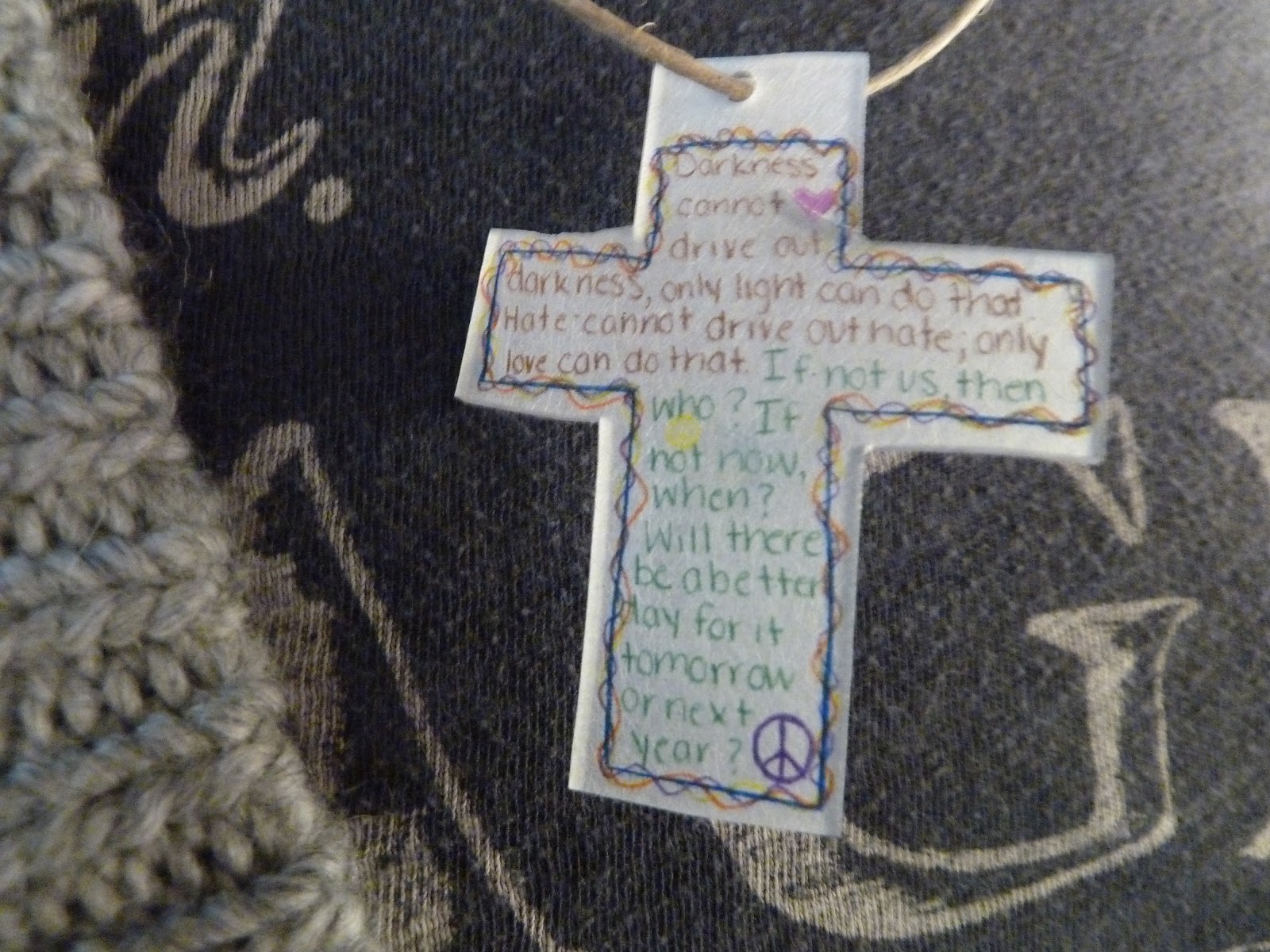 |
| medallion with quotes from ceremony |
We still emphasized the special role of children in the movement. This theme captures children's attention and imagination. It lets them build a bridge from a distant historical moment to the present in their quest for meaning and purpose. The world that Dr. King fought to change is so substantively different from the perspective of most youngsters today that they often don’t understand what the struggle was about.
And yet, if children half a century ago could move the needle on history then perhaps they can too! The belief that our convictions can lead to actions that make a lasting difference is such a crucial and exciting lesson for young citizens in our democracy. That Dr. King could inspire other children to march across time to bring our children this message is the finest thing I can think of on this holiday to celebrate.
Wednesday, December 7, 2011
Our Turtle Lives in the Bathtub
A few weeks ago we moved Harriet upstairs to her winter quarters. Her summer accommodations are more spacious. She’s got a lounging area, a larger master suite, an expansive outdoor deck with native plantings and constant running water. But if we left her there for the winter, chances are she’d freeze to death. Which would be a shame given that we have spent nine years keeping Harriet alive and trading up aquariums as she grew from the size of a quarter to her current 9” shell span.
 |
| Harriet basking in the sun in Shangri La. |
Her summer digs Rich, my live-in partner, dug for her four years ago…. by hand …with a pick axe. To specs provided by a consultant and our landscape designer who assured us that the pond we were creating (kind of a turtle Shangri-La) for our not so tiny red-eared slider would be a perfectly safe year round domicile for her to move to from the tank that had taken over half of our kitchen counter.
Harriet, who liked to eat from our hands and scramble up the ramp of the tank for her feedings (to the delight of visitors) transformed the moment we released her into her pond. No hesitant doleful glances over her shoulder. No, no, no. Our cheerful, indoor boarder never looked back. Harriet took one lumbering, clumsy splash into the deep, black beyond and we rarely saw her again that summer. She who used to creep now swam and dove. She was Esther Williams. Harriet who used to lounge for hours on the water dock in her aquarium, with one leg daintily stretched out behind her and her neck extended upwards toward the heat lamp seldom emerged from the water. Harriet the amphibian became a fish. At the approach of a human, she shot straight to the bottom like a submarine. “Dive, dive, dive, enemy bombers overhead!” If we waited patiently—say 20, 25, 30 minutes or so (sitting quietly without moving and practicing our oneness-with-nature skills), she might slowly resurface to feed from the small plastic sieve filled with turtle pellets—after she tried to snatch the sieve from your hand and compact it between her not so delicate reptilian beak. Think razor sharp pincer pliers clamped shut that maybe an iron crow bar could open. Harriet, our friendly, housebound, crowd pleasing reptile had gone native. Reverted to type. Trusted no one and nothing. Harriet seized her prey, jerked it roughly (think “neck snap”), then tried to drown it for good measure by dragging it underwater. Over time she settled down, but only with me. Rich cast too big a shadow (predator coming!) and didn’t have the patience to sit it out with her. The day she allowed me to pet her around her tiny shoulders and wrinkled neck registered as an unreasonable triumph. The salmonella carrier was allowing me to share her germs and I felt privileged! The queen had granted an audience: I was permitted to intrude upon her royal presence.
Harriet and I had come to an understanding! She would allow me to pet her if I would dangle my finger in the water to set up vibrations letting her know her food had arrived. Slowly, with the languidness of a grouper or swiftly with the aggressiveness of a great white shark (depending on her mood, the amount of sunlight and her appetite) she would emerge to check out the chef’s offering for the day. Was it human pinky finger, worms from the woods (a favorite delicacy), nova scotia salmon (the closest we could come to giving her live goldfish which we had mistakenly done early on in our Harriet stewardship; we thought we were providing a companion and she thought we were offering an h’ors doeuvre), or the predictable and pedestrian turtle pellets?
Life for Harriet was idyllic until the weather turned colder, the leaves began to fall and her owners began to angst. Was the pool actually deep enough for her to brumate? Turtles don’t hibernate. They’re way too cool for that. Their metabolisms slow down in the winter just like some of their mammalian sisters and brothers but they dig in under the wet mud and go into a kind of suspended state of animation for the cold winter months as long as they can stay below the frost line. Too high up and they turn into turtle pops. Call it mother’s intuition or owner’s guilt; we checked again with a different set of consultants and discovered that as magnificent as Harriet’s summer set-up was it would become her permanent tomb if we left her out there for the winter.
It was Lindsay, my older daughter and third child, who came up with the ingenious solution. It’s a good thing too, since it was Lindsay who saddled me with Harriet to begin with in the middle of her junior year of college. She arrived home with Harriet—who was then Huey—one cold winter weekend. Some kids bring home laundry. Others bring their pets. “Mom. He’s SO sick. I have to give him shots every day and I can’t do it. I’m scared he’s gonna die. PLEASE help me take care of him for a little while. The vet says it’s pneumonia.” This might possibly have been related to keeping Huey in an unheated aquarium in a student apartment in Bethlehem, PA in the middle of December. Huey and I bonded during his convalescence. There’s something about sticking a tiny turtle with a very sharp needle every day for 3 weeks and then feeding and soothing him immediately afterwards. He’s either gonna like you or hate you when it’s all over. Upon careful reflection, Lindsay believed that it would be in Huey’s better interests to be in a more stable environment. As Huey grew and graduated from one aquarium to the next and the next and the next and the next, it became apparent that Huey was Harriet. Sexing turtles is not a novice’s game.
Less than enthused with the idea of a 100 gallon tank dominating our kitchen counter, Rich and I were desperate for alternatives as we talked with Lindsay about the challenge of bringing Harriet back inside. “How about giving her away to a good home or nature center?” we proposed with a mixture of ambivalence and relief.
“Oh, Mom, you can’t do that! This is the only home she’s ever known!” It seemed that Harriet, who would as happily chomp down on my finger as on an earth worm, had a patrimonial claim to press. The college boyfriend’s whimsical $1.25 China Town pet store purchase (“Your girlfriend, she die salmonella, you no come back and bother me!”) had become the serious suburban multi thousand dollar investment. I was reminded ofThe Little Prince: “You are responsible forever for what you have named.” And if you aren’t, then Mom certainly is.
“If we put the tank in the basement where there’s room no one will ever visit her and she’ll be lonely,” I observed. “But when she’s in a tank she gets social again.”
“I know! Put her in my old bathtub.”
 |
| Lunchtime for Harriet |
At first the idea was so bizarre I rejected it out of hand. Who puts a turtle in a bathtub? Bath tubs are for people, the occasional dog and the passing pig (yes, we once had one of those too). Bath tubs are a place for carp before you make gefilte fish if you actually make gefilte fish. Within minutes though, the suggestion made perfect sense. The tub was big enough and deep enough. We could raise and lower the water when we needed to. Electrical power was close enough to supply the filter and the heat lamp. AND we could drain it by flipping a lever! You can’t do THAT with a tank. Oh, bliss! The bathroom wasn’t quite in the midst of daily traffic patterns but we wouldn’t be able to go through the day without passing the room.
So Harriet winters in the bathtub. It’s not exactly the Riviera but it beats being buried in the slimey ooze below the frost line. If I were a turtle and I had a choice I think I know which one I’d go for. She gets pellets, freeze dried shrimp, nova scotia, an occasional pass at my finger, an extra large new floating dock where she spends most of her day time hours, striking poses and basking in the glow of the heat lamp. We transfer some water lettuce from the pond to provide her with the cover she craves. We don’t think we should use the fake plastic plants we put in the first winter. It seems that turtles, like goats, will eat anything. I was still plucking tiny green plastic offerings from the outside pond the following August.
 |
| Thanks for the hand, Mom. |
Harriet’s now back for her third winter season at what we call Palm Beach. I look forward to our morning visits. We have our special time together. I use a hand net to skim clean the tub. She swims up to see what delicacies are on the daily menu and to get a scratch around the neck or on her legs. I like to think we are communing. In those few moments of quiet we are celebrating US and the fact that we meet a need for each other. I feed her and keep her tank tidy. She gives me a few moments of utter calm and concentration. All day long I am assaulted with messages and demands, electronic alerts and human requests, the complicated responsibilities of relationships and obligations. In these few moments everything else flies out of my head. It’s all about the simplicity of Harriet. “Enjoy me. Feed me. Pet me. Keep me clean.”
 |
| Harriet swimming in Palm Beach |
There’s just one hitch. We understand that turtles live for a really really long time. This means two things. 1) Harriet has retired and gone south before us. 2) Someone (are you reading this, Lindsay? ) is going to have take care of Harriet if she outlives us. She has, after all, become accustomed to a very high standard of care. Summers in Shangri La, winters in Palm Beach.
Monday, November 28, 2011
Why Rituals Are a Good Thing
Everywhere I go people are still discussing Thanksgiving celebrations. Their turkey was a big hit. They cooked more or less food than they needed. Thumbs up or down on ‘Thrifty Thursday’—the commercial prequel to ‘Black Friday.’ A new pumpkin pie recipe got rave reviews. Hosts of adult children and all their offspring are groaning as they clean up behind by their visitors. One friend is still looking for her husband’s I Phone. It was last seen in the same room as her 18 month old grandson. Unfortunately, no amusing You Tube video offers consolation. Another friend thinks that her kitchen may be in good working order by Christmas—just in time for the next onslaught. I’m sure there were family get-togethers that left folks less inclined to get together with family but I haven’t heard of any—just people enormously grateful for the chance to be with loved ones even with all the chaos and inconvenience that comes with long holiday weekend visits.
Sitting with my friend Karen over a cup of tea, she described her let down over the superb meal she and her family had shared. It surprised her. Preparing it together had been such a great bonding experience!Two days of planning and effort had gone into its execution. Her daughter-in-law-to-be wanted to do her family’s traditional shared gratitude reflections. But Karen didn’t think that would go down so well in a family adverse to public confessionals. Instead the group sat down at the table, thanked the chefs and demolished the fruits of their collective labor in about 20 minutes flat. The experience left both women feeling empty. Didn’t hearts and minds need to be fed in addition to tummies and taste buds? Wasn’t there a way to make this day different and more memorable than others? Wasn’t Thanksgiving supposed to mean something special? I agreed with Karen. It’s discouraging to work so hard on a meal and see it devoured in minutes with no acknowledgement of the unique purpose of the day. Just as we put time into planning for our food, we need to plan for our meaning. Purpose doesn’t magically materialize at our table any more than the food on our plates. If we leave that part of our celebration to happenstance it likely won’t happen.
At our table, we are accustomed now to the idea that Thanksgiving isn’t really about the meal. Good food matters but the meal is the symbol of what we have come to celebrate. We have passed through another year safely. We are saving up for another year, storing away memories of our time together. This is when everyone who is able makes a special effort to be there. We stop before we eat to talk about what is special about being Americans. We have ritualized the practice because we don’t trust ourselves to make it happen otherwise. Sure, we would have a bigger, better meal than usual (and everyone agreed that it was the best yet) but when it was over we’d have nothing more than fuller bellies. A ritual gives structure to our coming together and reminds us to stop and pay attention to this day and time together. As a result, we have years of a compelling tradition that has grown over time and that we associate with the holiday of Thanksgiving. This along with good food is what fills us with gratitude.
We aren’t slaves to a fixed ritual because that would bore everyone, instill thoughtlessness and incite rebellion. This year we adapted our practice and used “A Memory Harvest” to tell stories about people whom we love who are no longer with us. Children and grandchildren heard about 1st, 2nd and 3rd generation Americans who lived life in different ways and taught us lasting life lessons: “Adapt.” “Be kind.” “Take risks.” “Work hard.” “Be interesting.” “Have family dinners.” “No matter how busy you are there’s always time for play.”
I listened to Karen and Karen listened to me. “I think we’ll try your way next year. I hated getting up from the table and feeling like this was just another meal. We hadn’t created enough to remember.” National holidays are too special to let them pass without passing on the stories of your family and our nation. When you begin to experience the magical connections that appear when you connect the two, the holidays transcend food. They become about all the ways you and your loved ones can celebrate US.
Monday, November 21, 2011
Finding Gratitude in Gratitude Plates
This past week we worked with our partner Art with a Heart in Lakeland Elementary and Middle School, Monteverde Senior Center and Restoration Gardens, an interim housing site for young homeless adults. Using the project first developed with CMOM, the Children’s Museum of Manhattan (CMOM), we helped citizens from 7 to 70+ create Gratitude Plates that expressed what they’re thankful for as they approach Thanksgiving.
We hoped that participants would find the activity engaging. We brought plenty of supplies and gave schoolchildren paper and plastic plates and our adult artists glass plates to decorate. After introducing the exercise with a short discussion about the meaning of Thanksgiving and our country’s early experience with physical and political survival, participants drew, and pasted, glued and painted, and thoughtfully composed their amazing gratitude creations.
What surprised me was how absorbing the activity was for everyone regardless of age or setting. A good art activity should be as appealing as a pool on a hot day. Participants plunged right in.The noise level rose in every space as participants laughed, talked about what they were doing and cheerfully shared supplies and ideas. “You should put the dolphin here.” “Look! I found a great turkey for you!” “ How about this color green?” “You know I’m a pink girl!” The concept seemed to hit people where their hearts are and gave them a chance to connect the holiday with a symbolic object that made sense to them: it represented how (we eat) and why (we’re grateful for what we have) we celebrate Thanksgiving .
My assistant Tanya and I also took the project on Friday morning to Baltimore’s Kipp Ujima Village Academy where 100 5th graders made plates after doing their own version of the Freedom’s Feast Thanksgiving ceremony. There we had the same experience I had at the other sites. An hour just wasn’t enough. Once our artists got involved and committed to the idea it was hard for them to stop. They laid out designs and began to search for the colors, words and embellishments that would best represent their theme. Family was popular at Kipp with family pictures enhanced in thoughtful ways while others were grateful for music, food, friends, teachers, their school, the dream of a career. “I am thankful for a roof over my head” was accompanied by a picture of a nice house with a prominent roof. Another was grateful for “A mother’s power.”
At Restoration Gardens, Mone̕, a 19 year old resident created a stunning plate and wrote: “I am most thankful for living in the ghettos of Baltimore city because it carried me to struggles and without those struggles I wouldn’t be as strong as I am.” On the front of her plate she added a book. The book, she explained, will tell her story in images and symbols.
I am about to launch into my three day annual frenzy of Thanksgiving preparations. I have shopping lists that get re-edited, boxes of table decorations and seating plans that go back ten years. Almost everyone knows their food assignments. It will still be frenetic but everything will get done for our crowd of 25. On Thursday we will sit down to a beautiful meal and a meaningful experience as we do our version of the Try A Slice ceremony and inside of that tuck the Memory Harvest with 7 stories about family members who are no longer with us. Gratitude Plates will sit on our table and trigger more stories. This is our nation’s story. These are our stories. When else will we tell them? What I am grateful for going into these few days is that we can do this. But I am also grateful for the lessons these talented artists taught me this past week. The children at Kipp and Lakeland, the young adults at Restoration Gardens and the seniors at Monteverde reminded me that it is such a blessing to be able to create, to have a family, to have a roof over our heads, a good school, teachers we love, trials that test and strengthen us, friends we trust and special moments when we can stop and celebrate US. Enjoy your Thanksgiving wherever you are!
Subscribe to:
Posts (Atom)